Chameleon Circuit - The Doctor is Dying.mp3
All of the different versions of the TARDIS throughout the entire Doctor Who series.
Information taken from Wikipedia.
 The First Doctor's TARDIS. 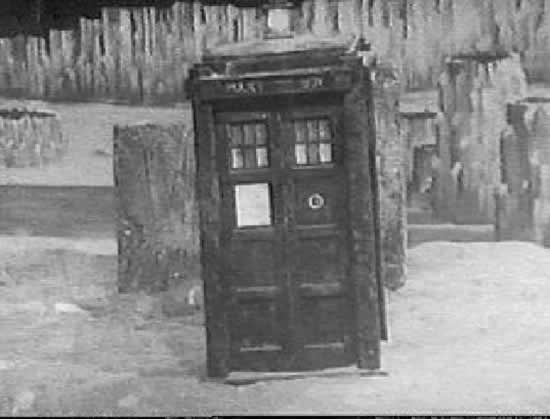 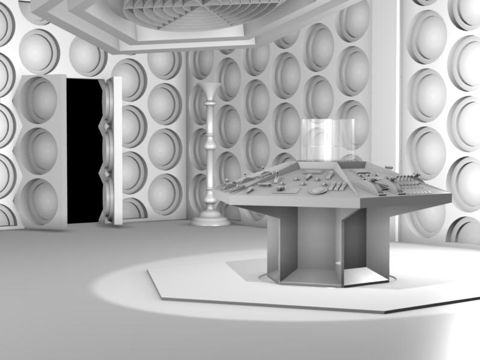 The Second Doctor's TARDIS.   The Third Doctor's TARDIS.   The Fourth Doctor's TARDIS.   The Fifth Doctor's TARDIS.   The Sixth Doctor's TARDIS.   Seventh Doctor's TARDIS.   Eighth Doctor's TARDIS.   Ninth Doctor's TARDIS.   Tenth Doctor's TARDIS.   Eleventh Doctor's TARDIS.    |
The TARDIS (Time and Relative Dimension in Space) is a time machine and spacecraft in the British science fiction television programme Doctor Who and its associated spin-offs. A TARDIS is a product of the advanced technology of the Time Lords, an extraterrestrial civilisation to which the programme's central character, the Doctor, belongs. A properly maintained and piloted TARDIS can transport its occupants to any point in time and any place in the universe. The interior of a TARDIS is much larger than its exterior, which can blend in with its surroundings using the ship's "chameleon circuit". TARDISes also possess a degree of sentience (which has been expressed in a variety of ways ranging from implied machine personality and free will through to the use of a conversant avatar) and provide their users with additional tools and abilities including a telepathically-based universal translation system. In the series, the Doctor pilots an unreliable, obsolete TT Type 40, Mark 3 TARDIS. Its chameleon circuit is faulty, leaving it stuck in the shape of a 1960s-style London police box after a visit to London in 1963. The Doctor's TARDIS was for most of the series's history said to have been stolen from the Time Lords' home planet, Gallifrey, where it was old, decommissioned and derelict (and, in fact, in a museum). However, during the events of "The Doctor's Wife" (2011), the ship's consciousness briefly inhabits a human body, and she reveals that far from being stolen, she left of her own free will. During this episode, she flirtatiously implies that she "stole" the Doctor rather than the other way around, although she does also refer to him as her "thief" in the same episode. The unpredictability of the TARDIS's short-range guidance (relative to the size of the Universe) has often been a plot point in the Doctor's travels. Also in "The Doctor's Wife", the TARDIS reveals that much of this "unpredictability" was actually intentional on her part in order to get the Doctor "where [he] needed to go" as opposed to where he "wanted to go". Although "TARDIS" is a type of craft rather than a specific one, the Doctor's TARDIS is usually referred to as "the" TARDIS or, in some of the earlier serials, just as "the ship", "the blue box", "the capsule" or even "the police box" and with the new Doctor "Sexy". Doctor Who has become so much a part of British popular culture that not only has the shape of the police box become more immediately associated with the TARDIS than with its real-world inspiration, the term "TARDIS-like" has been used to describe anything that seems to be bigger on the inside than on the outside. The name TARDIS is a registered trademark of the British Broadcasting Corporation. TARDISes are bioships that are grown from a species of coral presumably indigenous to Gallifrey, as shown in "The Impossible Planet," (2006) and it can take years to complete one. They draw their power from several sources, but primarily from the singularity of an artificial black hole, known as the Eye of Harmony. In The edge of Destruction (1964), the power source of the TARDIS (referred to as the "heart of the TARDIS") is said to be beneath the central column of the console. They are also said to draw power from the entire universe as revealed in the episode "Rise of the Cybermen" (2006), in which the TARDIS is brought to a parallel universe and cannot function without the use of a crystal power source from within the TARDIS, charged by the Doctor's life force. In the 2010 episode "Amy's Choice", the Doctor is seen to take various items out of a box, including an egg whisk and a corkscrew, to make a generator in the TARDIS, which is labelled: TARDIS, Time and Relative Dimension in Space, Build Site: Gallifrey Blackhole Shipyard, Type 40 Build Date: 1963, Authorised for use by qualified Time Lords only by the Shadow Proclamation, Misuse or Theft of any TARDIS will result in extreme penalties and possible exile.
The Doctor attempts to repair the chameleon circuit in Logopolis and Attack of the Cybermen, but the successful transformation of the TARDIS into the shapes of a pipe organ, a painted Welsh dresser (much to the amusement of Perpurgilliam "Peri" Brown and the Sixth Doctor's annoyance) and an elaborate gateway in the latter serial was followed by a return to the police box shape. The circuit was also repaired during the Virgin New Adventures novels, but again the TARDIS's shape was eventually set back to a police box shape. In "Boom Town" (2005), the Ninth Doctor implied that he had stopped trying to fix the circuit quite some time ago because he had become rather fond of the police box shape – a claim the Eighth Doctor made in the 1996 television movie. For most of the series run, the exterior doors of the police box operated separately from the heavier interior doors, although sometimes the two sets could open simultaneously to allow the ship's passengers to look directly outside and vice versa. The revived series' TARDIS features no such secondary doors; the police box doors open directly into the console room. The entrance to the TARDIS is capable of being locked and unlocked from the outside with a key, which the Doctor keeps on his person and occasionally gives copies of to his companions. In the 1996 television movie, the Eighth Doctor (and the Seventh before him) kept a spare key "in a cubbyhole behind the 'P'" (of the POLICE BOX sign). In The Invasion of Time a Citadel Guard on Gallifrey is initially baffled by the archaic lock when attempting to open the Doctor's TARDIS. Newer TARDIS models apparently have more advanced locking mechanisms that are touch-sensitive or may be operated by remote control. In "The Doctor's Wife," the TARDIS implies that she deliberately unlocked herself so the Doctor could steal her. In the 2008 episode "Forest of the Dead", River Song (a character whose timeline intersects with the Doctor in reverse order) says to the Doctor that she knows he would be able to open the TARDIS doors with a snap of his fingers. Although the Doctor dismisses this as impossible, at the conclusion of the episode, he opens and closes the doors by doing just that, eschewing the need for a key. The Eleventh Doctor also does this at the end of "The Eleventh Hour", when revealing the newly regenerated TARDIS interior to Amy Pond; he then does it again in "Day of the Moon". In the 2011 episode, "The Doctor's Wife", he tries to open it by snapping his fingers, but the door is locked by the mysterious entity, House. This ability seems to be unique to the Doctor, though, as he said Time Lords cannot do that. There is evidence that objects clinging to the outside of the TARDIS may be carried with it as it dematerialises. In Silver Nemesis (1988), an arrow is fired at the TARDIS and is embedded in its door. The arrow remains in the door throughout the serial and through several dematerialisations before being removed at the story's conclusion; this is repeated in "The Shakespere Code" (2007), and the arrow is removed in the following episode, "Gridlock. "Utopia" presented, for the first time on-screen, a circumstance in which a character travels on the exterior of the TARDIS during a flight, when Jack Harkness was somehow able to grab hold of the TARDIS as it began to dematerialise and hold on to its destination; the episode does establish, however, that a normal person would not have survived the trip, as Harkness is "killed" by the experience, but due to his immortality, soon revives. In "Vincent and the Doctor" (2010), some advertisements are attached to the TARDIS. After materialisation, they are shown to be burning. In the Seventh Doctor audio drama "Colditz", a character was killed by being halfway inside the TARDIS when it dematerialised. The exterior dimensions can be severed from the interior dimensions under extraordinary circumstances. In Frontios (1984), when the TARDIS was destroyed in a Tractator-induced meteor storm, the interior ended up outside the police box shell with various bits embedded in the surrounding rock. The Doctor eventually tricked the Gravis, leader of the Tractators, into reassembling the ship. In "Father's Day" (2005), a temporal paradox resulting in a wound in time threw the interior of the ship out of the wound, leaving the TARDIS an empty shell of a police box. The Doctor attempted to use the TARDIS key in conjunction with a small electrical charge to recover the ship, but the process was interrupted and the TARDIS was only restored after the paradox was resolved. The TARDIS interior has an unknown number of rooms and corridors. The exact dimensions of the interior have not been specified (although it has been said that it is about the size of the Empire State Building, The Invasion of Time), but apart from living quarters, the interior includes an ancillary power station disguised as an art gallery, a well-organised study (TARDIS, 2010), a greenhouse, bathroom, a library, a swimming pool, a medical bay, several squash courts, and several brick-walled storage areas The Invasion of Time (1978)). The Eleventh Doctor mentions a karaoke bar at one point, although he was lying at the time, so the karaoke bar may not actually exist ("The Girl Who Waited", 2011). There is also a secondary control room with ornate wood panels. Old (and future) control rooms can be "archived" by the TARDIS without the Doctor's knowledge, as seen in "The Doctor's Wife." Portions of the TARDIS can also be isolated or reconfigured; the Doctor was able to jettison 25% of the TARDIS's structure in Castrovalva to provide additional "thrust". In "The Doctor's Wife," this process is referred to as "deleting" rooms and is used to enable travel between universes. A fail-safe prevents living creatures from being "deleted" when the room is; they are instead transferred to the main control room. Rooms within the TARDIS can be re-arranged to suit the Doctor's needs, as when the Eleventh Doctor hastily moved the swimming pool beneath the TARDIS entrance in order to catch River Song in "Day of the Moon." A distinctive architectural feature of the TARDIS interior is the roundel. In the context of the TARDIS, a roundel is a circular decoration that adorns the walls of the rooms and corridors of the TARDIS, including the console room. Some roundels conceal TARDIS circuitry and devices, as seen in the serials The Wheel of Space (1968), Logopolis, Castrovalva (1981), Arc of Infinity (1983), Terminus(1983), and Attack of the Cybermen (1985). The design of the roundels has varied throughout the show's history, from a basic circular cut-out with black background to a photographic image printed on wall board, to translucent illuminated discs in later serials. In the secondary console room, most of the roundels were executed in recessed wood panelling, with a few decorative ones in what appeared to be stained glass. In the TARDIS design from 2005 – January 2010, the roundels are built into hexagonal recesses in the walls. After the TARDIS was regenerated at the beginning of the 2010 series, there are a range of different roundel designs around the control room. These include circular holes that are recessed deep into the walls, hexagonal holes that are lit from behind each face, round indents with brass rings around the outside, and a glass centre that is illuminated blue. Although the interior corridors were not initially seen in the 2005 series, the fact that they still exist was established in "The Unquiet Dead", when the Doctor gives Rose some very complicated directions to the TARDIS wardrobe. The wardrobe is mentioned several times in the original series and spin-off fiction, and seen in The Androids of Tara (1978), The Twin Dilemma (1984) and Time and the Rani (1987). The redesigned version, from which the Tenth Doctor chooses his new clothes, was seen in "The Christmas Invasion" (2005) as a large multi-levelled room with a helical staircase. Designer Ed Thomas has suggested that more rooms may be seen in coming episodes. The corridors were eventually seen in the episode "The Doctor's Wife," and are currently standing sets for use in future episodes. The Doctor also mentions in "The Shakespeare Code" that the TARDIS has an attic. In The Eleventh Hour, the Doctor mentions that the TARDIS has a library and a swimming pool. He tells Captain Avery that there are several bathrooms available in "The Curse of the Black Spot" (2011). The swimming pool has been seen on-screen in The Invasion of Time (1978), and the Doctor later used it to catch River Song as she plummeted from a skyscraper. The swimming pool, the scullery, squash court 7, the archived Ninth and Tenth Doctor's console room, and Amy and Rory's quarters were ejected in the episode "The Doctor's Wife." The Doctor reconstructed Amy and Rory's bedroom but replaced the bunk beds – on which River Song was presumably conceived – with a normal bed at their insistence. The most often-seen room of the TARDIS is its console room, where its flight controls are housed. The console room was designed by Peter Brachacki and was the only set he designed for the show. It was built on a shoestring budget and a tight schedule, which led to Brachacki leaving the show due to disagreements with the production team and possibly a feeling that he had been given an impossible task. Despite his leaving the show and mixed reactions as to how the set looked (producer Verity Lambert liked it but director Waris Hussein did not), the basic design of the hexagonal console and wall roundels has persisted to the present day. In the 2005 series, the console room became a dome-shaped chamber with organic-looking support columns, and the interior doors were removed. The change in configuration is explained in "Time Crash" by the Fifth Doctor as a mere changing of "the desktop theme" to "Coral" (he also indicates that a "Leopard Skin" theme is also available, but he dislikes it). Other preceding theories involve the fact that the TARDIS interior was severely damaged by a cold fusion explosion in The Gallifrey Chronicles. Several episodes of the revived series, such as "Army of Ghosts" and the end of "The Unicorn and the Wasp", reveal that there is storage space directly underneath the console room; the Doctor is shown periodically obtaining equipment from this area via a panel in the floor. The 2005 console room was destroyed by the regeneration energy of the Tenth Doctor in the final scene of "The End of Time" and cold open of "The Eleventh Hour", although it made a reappearance in the 2011 episode "The Doctor's Wife". A new console room, along with a new police box exterior, made its debut in the Eleventh Doctor's first episode, which aired on 3 April 2010. It was revealed in "The Doctor's Wife" that the older TARDIS interior designs are not destroyed or remodelled, but 'archived' off the official schematic without the Doctor's knowledge. The TARDIS reveals that she has around 30 console rooms archived, even those that the Doctor has yet to use. These archived console rooms are still capable of controlling TARDIS functions as shown when Amy and Rory are able to lower the TARDIS shields from an archived control room. The active console room at a given time will be the one connected to the exterior doors for ingress and egress. The main feature of the console rooms, in any of the known configurations, is the TARDIS console that holds the instruments that control the ship's functions. The appearance of the primary TARDIS consoles has varied widely but shares common details: hexagonal pedestals with controls around the periphery, and a moveable column (or time rotor as it has been called in the original series and the 2011 episode "The Doctor's Wife") in the centre that bobs rhythmically up and down when the TARDIS is in flight, like a pump or a piston. The arrangement of the controls implies that the console was designed to be manned by more than one person. One piece of fan continuity, used in the spin-off media, and also mentioned by the current production team, is that the intended number of operators is somewhere between three and six. In "Journey's End", the Doctor confirms that the intended number is six; Rose Tyler, Martha Jones, Sarah Jane Smith, Mickey Smith, Jack Harkness and the Doctor man the controls, and the TARDIS runs far more smoothly during that brief period than it normally does. This also explains why the Doctor tends to do a lot of manic running around the console while he is piloting the TARDIS, as well as the occasional difficulty he has in controlling it, although Romana, the Doctor's one-time Time Lord companion, is able to pilot the TARDIS successfully by herself. Companion Professor River Song, herself a de facto Time Lord who was conceived aboard the TARDIS while transiting the time vortex, was also shown to pilot the TARDIS smoothly and easily without help ("The Time of Angels", "The Pandorica Opens", "Let's Kill Hitler", "The Angels Take Manhattan"). The central column is often referred to as the "time rotor", although when the term was first used in The Chase (1965) it referred to a different instrument on the TARDIS console. However, the use of this term to describe the central column was common in fan literature, and was finally used on screen to refer to the central column in Arc Of Infinity(1983) and Terminus(1983). The current production team uses the term in the same way. It was also referred to as the "time column" in Logopolis (1981). Precisely how much control the Doctor has in directing the TARDIS has varied over the course of the series. The First Doctor did not initially seem to be able to steer it accurately, making only one intended landing to the planet Kembel in The Daleks' Master Plan (1965–6) by using the directional unit taken from another TARDIS before the unit burns out. During the Third Doctor's exile on Earth, the TARDIS's course is shown as controlled successfully by the Time Lords, and from the point the Time Lords unblock his memory of time-travel mechanics in "The Three Doctors" (1972–3), the Doctor seems able to navigate correctly when needed. Due to the age of the TARDIS, it is inclined to break down. The Doctor is often seen with his head stuck in a panel carrying out maintenance of some kind or another, and he occasionally has to give it "Percussive Maintenence" (a good thump on the console) to get it to start working properly. Efforts to repair, control, and maintain the TARDIS have been frequent plot devices throughout the show's run, creating the amusing irony of a highly advanced time machine which, at the same time, is an obsolete and unreliable piece of junk. Additionally, the TARDIS was designed to be flown by six experienced Time Lords, as opposed to the one Doctor piloting (and, often, not very well.) The TARDIS possesses telepathic circuits, although the Doctor prefers to pilot it manually. In Pyramids of Mars (1975), the Fourth Doctor told Sutekh that the TARDIS controls were "isomophic", meaning only the Doctor could operate them. However, this characteristic seems to appear and disappear when dramatically convenient, and various companions have been seen to be able to operate the TARDIS and even fly it. In "Blink", the TARDIS was 'pre-programmed' to travel to a specific time (1969) and place by inserting a DVD into the console. The DVD was one of the 17 owned by Sally Sparrow on which the Doctor appeared as an 'Easter Egg.' In this situation, however, the TARDIS dematerialised without transporting its occupants. Despite the changes in the layout of the console controls, the Doctor seems to have no difficulty in operating the ship. In "Time Crash", the Fifth Doctor was able to fly the TARDIS even though the console was radically different from the one he was used to, at first without even noticing that the machine had changed. In the episode "Utopia" the TARDIS was taken by the Master and the Doctor was only able to use his sonic screwdriver to restrict the destination times to the last two previous selected destinations. In the Big Finish Productions audio play Other Lives (2005), the Eighth Doctor deactivates the isomorphism of the controls to allow his companion C'rizz to operate the console. The 2005 series also sees the addition of the tribophysical waveform macro kinetic extrapolator to the TARDIS in the episode "Boom Town". This control was originally a pan-dimensional 'surf board' taken from the Slitheen. In the 2005 episode "The Parting of the Ways", Captain Jack Harkness uses it to rig up a force field that defends the ship from Dalek missiles. The Doctor uses it again in the Christmas 2006 episode "The Runaway Bride", to jar it a few hundred metres off course when being dragged back to the Empress of Racnoss, in a similar manoeuvre to one he used in The Web of Fear with another extra device he plugged into the console. In the last appearance, the TARDIS coral has begun to grow over the extrapolator. Despite its outside appearance, the TARDIS seems to be virtually impenetrable. Once, when being chased by a monster, the Doctor reassured his would-be companion, Rose Tyler, that "the assembled hordes of Genghis Khan couldn't break through those doors, and believe me, they've tried." When fully active, the TARDIS's outer defences are (nearly) impenetrable, though in "Journeys End" the Tenth Doctor says of the Dalek Empire "they're experts at fighting Tardises, they can do anything, right now that wooden door is only wood." This is demonstrated in the last episode of The Armageddon Factor. In this episode, the Black Guardian is unable to enter the TARDIS after the Doctor activates "...all of the TARDIS's defences..." The result is that the Black Guardian is unable to obtain the much-desired Key To Time. Some of the TARDIS's other functions include a force field and the Hostile Action Displacement System (HADS), which can teleport the ship away if it is attacked (The Crotons, 1968). The force field is still on the TARDIS, as seen in "The Runaway bride", when the Tenth Doctor and the Bride, Donna Noble, are trying to escape the Empress of the Racnoss. In "Journey's End", the Doctor states that the Daleks created and led by Davros would have no problem breaching the TARDIS defences. Another device, a tribophysical waveform macro kinetic extrapolator, is installed to generate a force field in the episode "Boom Town" and is later used to protect the ship from Dalek missiles in "The Parting of the Ways". Note From the Owner: Now, I don't know about any of you, but if you have seen the new Doctor Who Christmas special, maybe you can tell me exactly why Matt Smith had a new TARDIS interior? All of the other Doctor's shared them or got a brand new one with their new regeneration. Examples of sharing: Throughout ALL of the old school episodes, as you can see on the left interior pictures. Nine and Ten shared the interior of their TARDIS as well. I'm not complaining, I like the new design, but still it hardly seems fair for the man to get two different ones. Don't know about you, but I smell some bribing or maybe a family member high up in the show's list of creators. -Time Lady Sonya- |
